There is no single first AI-generated image. The answer depends on what you count. Computer-drawn art starts in the early 1960s. The first program built to make art decisions on its own, Harold Cohen's AARON, has its first image dated to 1973, and that is the usual answer. The first pictures made from a typed sentence came from research published in 2016, and the first text-to-image system most people saw was DALL-E in 2021.
You can make your own first AI image on FreeGen, a free text-to-image generator with no signup, using the same prompt researchers tested in 2016; the steps are at the end. First, this article puts each of those firsts on one dated timeline, says what the early images were like, and explains how the methods differ.
If you need one citable answer for a paper or a quiz, use AARON and 1973, and add a line saying which definition you mean. The table below shows why.
Which "first" do you mean?
The disagreement between sources is almost always a disagreement about definitions. Pick the definition and the answer follows.
| If "first AI image" means... | The answer | Date |
|---|---|---|
| Any art drawn by a computer program | Plotter works by A. Michael Noll, Frieder Nake and Georg Nees | 1961 onward |
| A program that makes its own artistic choices | Harold Cohen's AARON | First image 1973 |
| An image from a neural network that learned from data | GAN-based and DeepDream images | 2010s (DeepDream 2015) |
| An image generated from a written caption | "Generating Images from Captions" research | 2016 |
| The first AI artwork sold at a major auction | Portrait of Edmond de Belamy, by Obvious | 2018 |
| The first text-to-image tool the public widely saw | OpenAI's DALL-E | 2021 |
Each row is a real first. They just answer different questions.
The 1960s: computer art before AI
The earliest computer-made pictures were not AI in the modern sense. They were algorithmic art: an artist-programmer wrote instructions, and a machine called a plotter moved a pen across paper to carry them out. The program followed fixed math. It did not learn, and it did not choose.
Three names come up again and again, sometimes called the "3Ns" of digital graphics:
- A. Michael Noll began making computer art at Bell Labs in New Jersey in 1961. He was the first United States computer artist to exhibit at the Howard Wise Gallery.
- Frieder Nake produced his first work, the portfolio Matrizenmultiplikation, in 1963.
- Georg Nees, who worked at Siemens on the Zuse Graphomat Z64 drawing machine, showed his computer graphics in an exhibition in 1965, described as the first by a generative computer graphic artist.
If someone tells you the first AI image is from the 1960s, this is what they mean. It is the first computer art, and the starting point for everything after it, but it sits just outside most definitions of artificial intelligence.
AARON: the usual answer, from 1973
Harold Cohen was an artist and programmer. He conceived AARON in the late 1960s at UC San Diego and gave it its name in the early 1970s. The first AARON image is dated to 1973, and that date is the one most often given for the first AI-generated image. The Whitney Museum of American Art has described AARON as the earliest AI program for artmaking.
What made AARON different from 1960s plotter art was that it made decisions. Cohen wrote rules about how to draw, in the Lisp programming language, and AARON used those rules to compose its own pictures of plants, people and abstract scenes. Cohen did not tell it what each picture should be. He told it how to draw, and it decided what to draw.
What the early drawings looked like
Early AARON made black-and-white line drawings, and only that. If a drawing was to have colour, Cohen added it by hand. Cohen also built his own plotters and painting machines to put AARON's drawings on paper, and later machines added colour with brushes. In the 1980s he changed AARON so it could choose and apply colours itself.
Where AARON has been shown
AARON was first shown at the Los Angeles County Museum of Art in 1979. It has since been displayed at the Tate Modern in London and the Whitney in New York, where the exhibition "Harold Cohen: AARON" ran from February 3 to May 19, 2024. Museum collections and exhibition catalogues are the place to look for the actual drawings. AARON itself has not been updated since Cohen died in 2016.
How AARON differs from today's models
In one line: AARON followed art rules that Cohen wrote by hand, while modern generators learn patterns from huge numbers of images and use neural networks. AARON had no training data at all. Everything it knew, Cohen typed in.
From rules to learning: GANs and DeepDream
The next big shift was machine learning. Instead of writing rules, researchers let a program learn what images look like by showing it examples.
The key idea was the generative adversarial network, or GAN, credited to the researcher Ian Goodfellow. A GAN uses two neural networks. One learns from a set of images and generates new examples. The other judges whether each example is real or fake. As they compete, the generator gets better at producing images the judge cannot reject.
Around the same period, Google's DeepDream (2015) used a convolutional neural network to generate hallucinatory visuals.
Neither of these let you type what you wanted. That came next.
2016: the first pictures made from a sentence
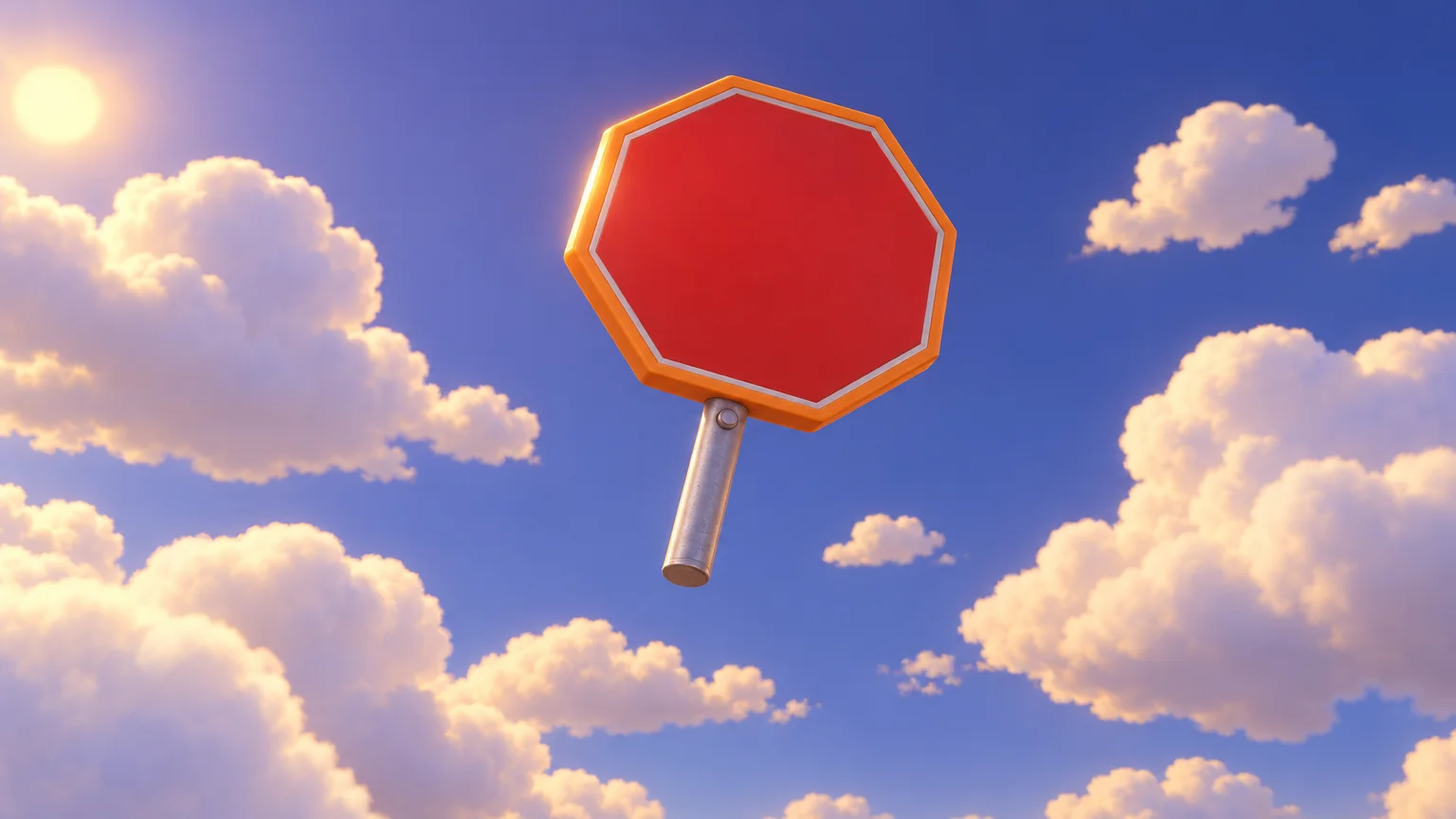
The paper "Generating Images from Captions" (arXiv 1511.02793), published in 2016, is the early landmark for text-to-image generation. The researchers fed the model short written captions and asked it to produce matching pictures. One of the prompts was:
a stop sign is flying in blue skies
The paper produced images from captions such as that one. The idea was there: a sentence in, a picture out. Every text-to-image tool you can use today, including the one at the end of this article, works on that same basic contract.
2018: Portrait of Edmond de Belamy goes to auction
In October 2018, Christie's in New York put a GAN-made painting up for sale. Portrait of Edmond de Belamy is described as the first AI-generated portrait sold at auction, and it was part of the 2018 series La Famille de Belamy.
The details that most summaries skip:
- Who made it: Obvious, a French collective made up of Hugo Caselles-Dupré, Pierre Fautrel and Gauthier Vernier.
- How: a GAN trained on 15,000 portraits painted between the 14th and 20th centuries.
- Where: Christie's Prints and Multiples sale in New York, held October 23 to 25, billed as the first major auction of AI-created artworks.
- The price: it was estimated at up to $12,000 and sold for $432,500.
The sale made headlines because of that gap between estimate and price, and it started arguments that are still going: who the author is when a model makes the image, who owns the result, and whether training on other people's art is fair. Those questions now apply to every AI image, including yours. Our guide to how AI image generators work covers the ownership side in plain terms.
2021 and 2022: DALL-E, Craiyon and DALL-E 2
In 2021 OpenAI announced DALL-E, a system that generated images from a text prompt. For most people this was the turning point: the first time text-to-image felt like something real rather than a research demo. The images were still weird and blurry.
The weirdness became its own entertainment. Craiyon turned into a niche internet trend, with people typing absurd prompts just to see the strange results and sharing them as memes.
Then came DALL-E 2, which used diffusion models. The jump in quality was large. Some pages date DALL-E 2 to 2023, but OpenAI's own record puts it earlier: by July 2022 it was in research preview, with more than 3,000 artists from more than 118 countries using it. On July 20, 2022, OpenAI began inviting 1 million people from its waitlist to the DALL-E beta.
That 2022 beta shows how different access was then. Each user got 50 free credits in the first month and 15 a month after that. One credit bought one prompt returning four images, and extra credits were sold in blocks of 115 for $15. The beta gave users commercial rights to their images and rejected uploads of realistic faces and attempts at public figures' likenesses. You needed an invitation and an account to try any of it.
2023 to today: photoreal still images
Access changed just as much as quality. In 1973 you needed to be Harold Cohen. In 2022 you needed an invitation. Now you can open a browser tab.
Make your own first AI image
You have read about everyone else's first AI image. Making yours takes a few seconds. FreeGen's free AI image generator runs on the Z-Image Turbo model, needs no account or signup, and as of November 2026 returns a 1024×768 image, typically in under 10 seconds.
- Type a prompt into the text box. Start with the 2016 one, exactly as written:
a stop sign is flying in blue skies - Choose an aspect ratio. The options are 1:1, 4:3, 3:4, 16:9 and 9:16. Try 4:3 for this one.
- Optionally upload a reference image if you want image-to-image instead of text-to-image. Skip it for now.
- Click Generate, then right-click the result to save it.
It is the same sentence the 2016 researchers used, a decade later.
Then try a prompt from each era of this timeline:
- AARON, 1973:
black and white ink line drawing of potted plants and two standing figures, loose pen plotter lines on white paper, no shading - Belamy, 2018:
unfinished oil portrait of a man in a dark coat with a white collar, blurred smeared face, dark background, old master style - DALL-E and Craiyon, 2021–2022:
a teapot shaped like an avocado sitting on a kitchen table, slightly strange and dreamlike
A model will not always match a prompt exactly, so if a result misses, change one detail and generate again. To see what different prompts produce before you write your own, the examples gallery shows images alongside the prompts that made them, and one-line prompts to copy and paste gives you more to start from. Keep it to the kinds of images the site allows: no real people without their consent, and no adult, violent or disturbing content.
Frequently Asked Questions
Is AARON still making new art?
No. AARON has not been updated since Harold Cohen died in 2016. Its body of work runs from the 1973 black-and-white drawings through the colour pieces that followed Cohen's 1980s changes, and it is now shown as historical work in museums such as the Whitney and the Tate Modern.
Was Portrait of Edmond de Belamy made entirely by a machine?
The image was produced by a GAN, but people chose the training images, built the setup and selected and printed the result. Obvious trained the model on 15,000 historical portraits. That mix of human choices and machine output is exactly why the sale started the authorship debate.
Can I use the first image I make on FreeGen?
Yes. As of November 2026, FreeGen's terms say images can be used for personal and commercial projects and that you keep the rights to what you generate. The same terms ask you not to make images of real people without their consent.
Why did early text-to-image results look so blurry?
The first DALL-E, from about 2021, produced weird, blurry images. DALL-E 2 moved to diffusion models, and the jump in quality was large; by 2023 AI images were starting to look photorealistic.
Final Thoughts
If you need a single answer, say AARON, 1973, and name the definition you are using. If you would rather understand the history by doing it, run the stop-sign prompt once, then run the AARON-style line drawing prompt and look at the two side by side. For a longer look at what counts as AI art and the argument over whether it is art at all, read What Is Artificial Intelligence Art?.